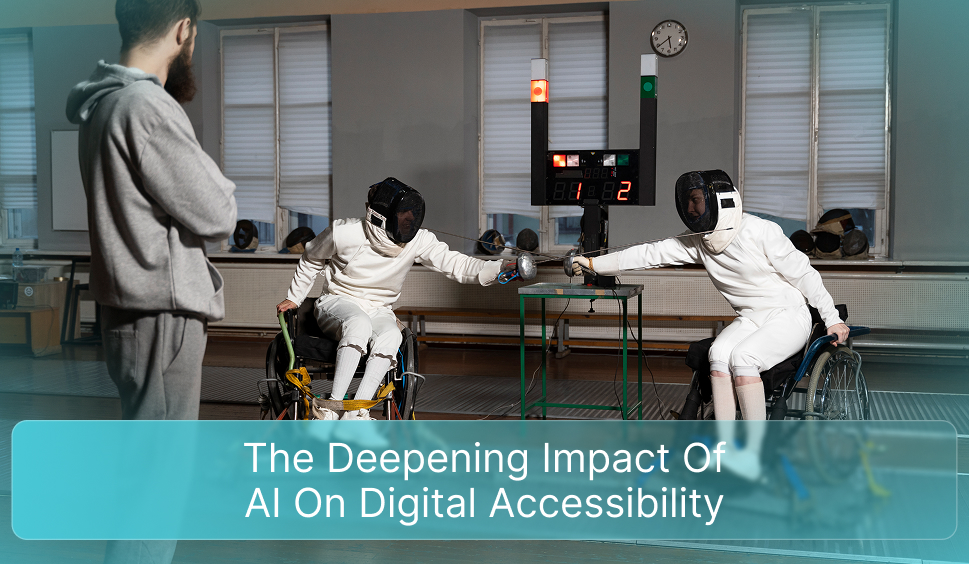
How Ai is Transforming the Future of Digital Accessibility
Artificial Intelligence (AI) is transforming the digital landscape, breaking barriers, and making the online world more inclusive. As the global population increasingly relies on digital platforms for work, education, and communication, ensuring accessibility for everyone, including the 1.3 billion people globally with disabilities, has become a moral and legal imperative. AI is evolving as a key player in this mission, offering innovative tools that streamline accessibility while enhancing compliance with global standards such as WCAG (Web Content Accessibility Guidelines) and the Americans with Disabilities Act (ADA).
AI’s Expanding Role in Digital Accessibility
AI is helping bridge the gap between technology and accessibility by automating critical tasks. Modern AI tools can now craft captions for videos, suggest alt text for images, transcribe spoken words into text, and even detect poor contrast ratios on websites. These features not only improve usability but also make compliance with accessibility guidelines more effective and cost-effective. However, AI isn’t a complete substitution for human oversight. While algorithms can speed up accessibility efforts, they can also introduce errors or perpetuate biases if not cautiously supervised.
The World Health Organization (WHO) reports that more than a billion people experience significant disabilities, many of whom rely on assistive technologies. AI is revolutionizing how these individuals connect with technology, from automated transcription of meetings to email composition tools and image-to-text converters. These advancements are creating more inclusive workplaces and educational environments that empower people to participate equally.
Improving Accessibility Across the Workplace
AI is redefining accessibility in professional spaces, touching every view of the employee experience, from hiring to daily productivity. In recruitment, AI-driven platforms like Workable and hireEZ can analyze profiles and match candidates with job descriptions, potentially reducing bias in hiring. Meanwhile, tools such as Pymetrics have experimented with AI-powered games built to assess skills objectively, encouraging fairer hiring practices.
Yet, these systems must be managed responsibly. The ADA warns that over-dependence on automated hiring tools without human review can unintentionally filter out qualified candidates with disabilities. It highlights the importance of maintaining a balance between automation and empathy, ensuring that AI supports inclusion rather than obstructs it.
For employees already in the workforce, AI tools are proving transformative. Applications such as Microsoft’s Seeing AI and Be My Eyes offer real-time audio descriptions for visually impaired users, while Google’s Live Transcribe and Descript assist those who are hard of hearing by converting conversations into accurate text. Text-to-speech software like NaturalReader further improves information accessibility, making content available in different formats. Collectively, these innovations embody the principles of universal design, creating spaces that can be understood and used by everyone, irrespective of ability.
Enhancing Web and Digital Experiences
The web remains a main frontier for accessibility, and AI is leading the charge in making it more inclusive. Following WCAG standards means ensuring that websites offer proper color contrast, descriptive alt text, navigable layouts, and captioned media. AI-driven accessibility tools can now automate many of these processes by identifying low-contrast text, generating captions, and suggesting alt descriptions.
However, accuracy and context remain concerns. Some AI-generated captions or summaries may comprise factual or interpretive errors, which can confuse or misinform users with disabilities. Researchers have also found that certain AI systems display biases, for example, misclassifying disability-related language as negative or inappropriate. Such limitations highlight the need for human validation and diverse, representative training data.
Experts emphasize the importance of involving people with disabilities in every stage of AI development. Diverse datasets help reduce bias and ensure that technology works for everyone. The U.S. Access Board recommends persistent evaluation of AI tools, particularly in workplace monitoring or “bossware” systems, which can misapprehend the performance of employees with disabilities. Addressing these issues early on is crucial for creating equitable technological ecosystems.
The Road Ahead: Balancing Potential and Responsibility
AI’s growing influence in accessibility has already revolutionized digital inclusion, enabling businesses and developers to meet accessibility goals more affordably and efficiently. Yet, true inclusivity needs more than automation. It demands collaboration between developers, accessibility experts, and end users to ensure that technology empowers rather than excludes.
AI has made noteworthy strides, but it cannot replace the human touch. By knowing its restrictions and ensuring ethical implementation, we can build a future where technology genuinely serves everyone, regardless of ability.
How WAC Helps Businesses Improve Digital Accessibility?
While AI-powered tools enhance accessibility creation, continuous evaluation remains vital. Web Accessibility Checker (WAC) assists organizations by scanning digital assets and generating comprehensive accessibility reports. These reports highlight concerns such as missing alt text, poor contrast ratios, or navigation challenges, allowing teams to understand where accessibility gaps exist. Though WAC doesn’t make websites accessible directly, it enables businesses to take informed, actionable steps toward compliance and inclusivity.
Get Your Website’s Accessibility Checked by Experts
Let's Connect

 Let's Discuss Your Tech Solutions